
$6.99
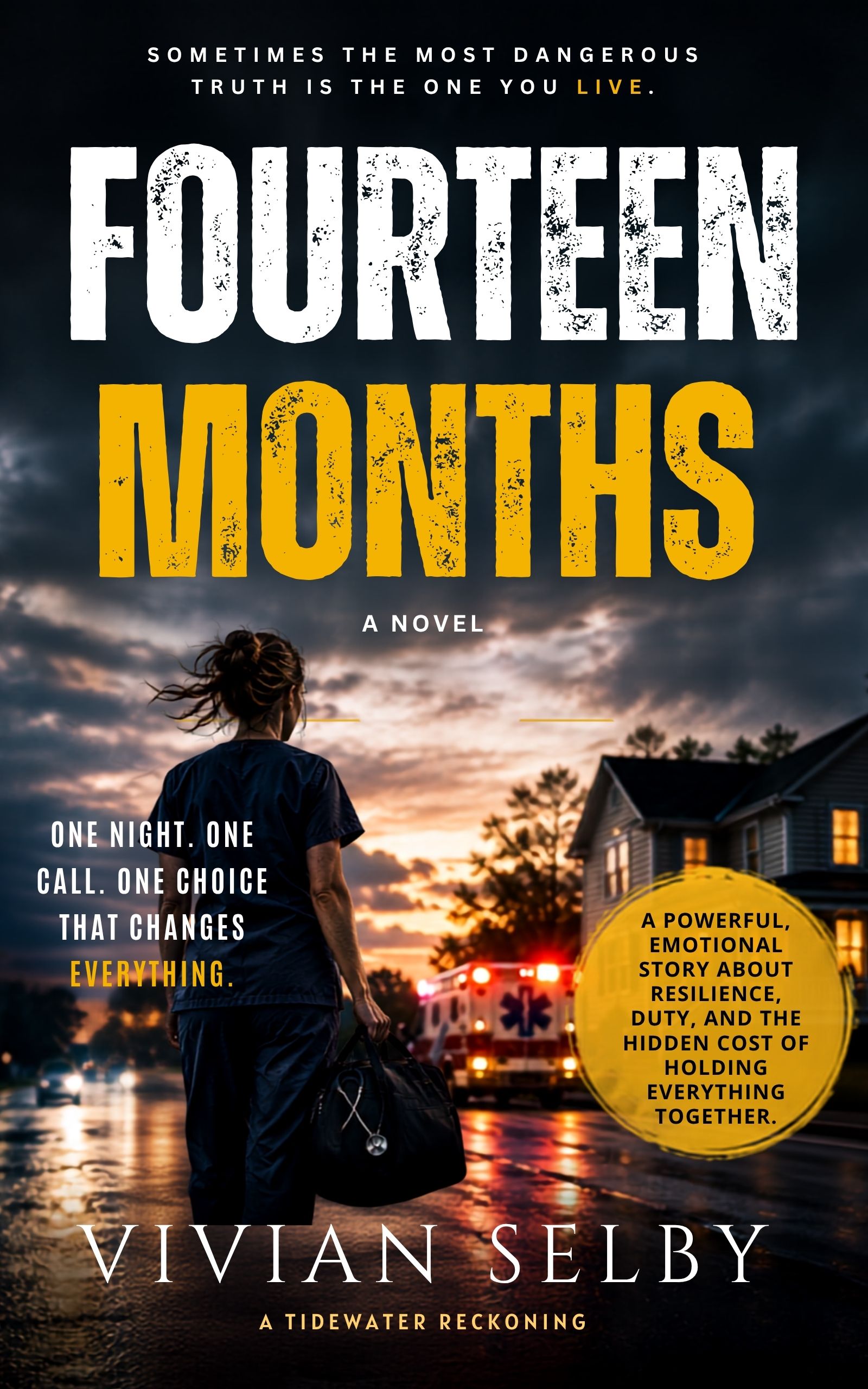
Delia Machen is the hospice nurse for a Virginia county of eight thousand people. She has managed four hundred deaths. At two in the morning she finds her husband on the bathroom floor — and by dawn she is standing opposite a stranger holding a document that gives her no say in any of it. There is no affair. What he did instead is worse.
Description
She has managed four hundred deaths in this county. She was not permitted to manage his.
Delia Machen is the hospice nurse for Mathews County, Virginia — eight thousand people, no hospital, one rescue squad, and a woman who has sat at four hundred kitchen tables and told four hundred families exactly what is about to happen.
At twenty to two on a February morning, the bed is shaking, and it is her own.
Her husband is on the bathroom floor between the tub and the toilet, going hard, with a fever she recognizes before she is fully awake. She does what she has done in a hundred other people’s houses: counts, gets a towel around him, reaches for his phone.
It is already in his hand. The call has been connected for nine minutes.
“Roy, honey. Are you still there.”
Delia says this is his wife — and hears the pause on the other end. After twenty-two years of listening to people receive news she knows precisely what surprise sounds like, and this is not it. This is a woman rearranging something she had already built.
“Tell them biliary,” the voice says. “Tell them he’s got a stent.”
By seven Delia is standing in a corridor in Richmond, seventy miles from home, opposite a woman she has never seen — who is holding a photograph of a document Delia has never read, with Roy’s signature on it, dated fourteen months ago.
There is no affair
That is the first thing everyone will assume and the first thing Delia rules out. What her husband did instead is harder to look at, it has been going on since the December before last, and he was five days from getting away with it.
The law is not on her side either, because the law was never asked to be. Two people over eighteen watched a man write his name on a form, and that is the entire ceremony the Commonwealth of Virginia requires. No notary. No notice to the wife. No requirement that the person named even be told. “You need a notary to sell a truck,” Delia says, and the lawyer across the desk agrees, and tells her he has thought about that more than once.
The hardest kind of wrong to be
Roy is not a villain. He is wrong about the thing that matters most and right about nearly everything else, which is the worst way a person can be wrong. He did not do this to hurt his wife. He looked across thirty-one years and reached a conclusion about her — and the unbearable part is how close to accurate it was.
Delia is not innocent either. That arrives later, and it arrives out of her own career.
Nobody in this novel takes anything from anybody. That is exactly why it costs more than a betrayal would.
A novel about competence
Fourteen Months is about a woman so reliable that the people who loved her stopped bringing her anything difficult — and never once told her that was what they were doing.
Mathews County, and the water coming up
Route 14 out of Cobbs Creek, empty at two in the morning. Squad crews you went to school with. Scrape boats going out in the dark twelve days into oyster season. A field that was a field when you were young and is mostly a pond now. A Food Lion parking lot where people ask you about their mother’s swelling, and a marsh that turns green in a single morning at the end of April.
The same tidewater country as Every Third Thursday — the flat roads, the pine, the small county courthouses, the towns where everybody minds their business and knows everything anyway.
For readers who
Want their suspense quiet, domestic and moral rather than violent. No menace, nobody to hate, no violence on the page and effectively no profanity. What there is instead is a competent woman discovering that being the one who handles everything is the reason nobody tells her anything — and a marriage that ran for thirty-one years on a rule neither person ever said out loud.
In this edition
- The complete novel in three acts — Rigors, Capacity, Disposition — across thirty chapters
- Twelve questions for discussion. The first asks whether being right about somebody gives you any standing to decide for them.
- A note from the author on the rule this book began with, on why Roy is not a villain, and on which parts of Virginia law here are real — including the two she most wants you to know are
The second novel in the Tidewater Reckoning series. Each book stands entirely alone.
Instant digital download.
Please note: This is a work of fiction. Names, characters, businesses, organizations, places, events and incidents are the product of the author’s imagination or are used fictitiously. While certain real geographic locations in the Commonwealth of Virginia are referred to, all institutions, agencies, officials and proceedings depicted are fictional, and characters who speak about the law are speaking in character and are sometimes wrong. Nothing in this book should be relied upon as a statement of law, legal procedure, medical fact or insurance practice — a reader with a real question of this kind should ask a lawyer, a physician or a licensed adviser, not a novel. The story deals throughout with terminal illness, hospice and end-of-life care, medical decision-making, and the death of a spouse.
Related products
-

The All-New Low Calorie High Protein Low Carb Diet Cookbook – EBK
$6.99 Add to cart -
The All-New Low Calorie High Protein Low Carb Diet Cookbook – PBK
$24.95 Add to cart -

The All-New Intermittent Fasting for Seniors – EBK
$6.99 Add to cart -

The All-New Pritikin Diet for Seniors (Third Edition) – EBK
$6.99 Add to cart